Train to become a
Forest Therapy Guide.
The questions and reflections below are here to help you explore guided forest therapy, understand our mindful approach, and begin finding your way into this work.
Through accessible, grounded training and certification, The Forest Therapy School helps you build the skills and confidence to guide meaningful forest therapy walks.
What is Forest Therapy?
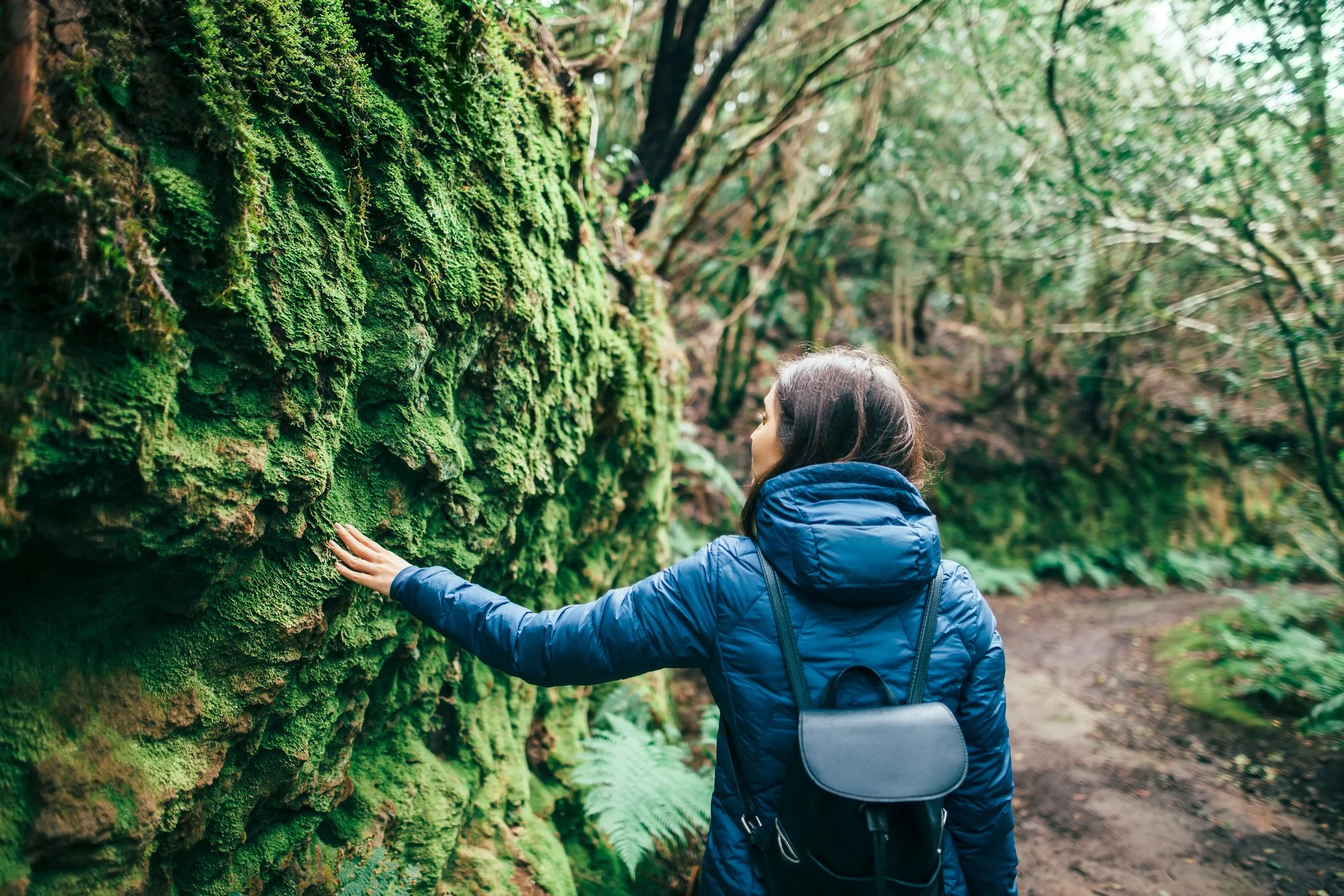
Forest therapy is a guided practice of slowing down in nature, opening the senses, and connecting with the living world. Inspired by Shinrin-Yoku, or forest bathing, it invites people to experience the forest through embodied sensory awareness: sight, sound, scent, touch, taste, movement, stillness, and relationship.
At The Forest Therapy School, we teach forest therapy as a mindful practice of being with nature. A trained guide holds the pace, sequence, language, silence, and sharing so participants can settle into the present moment and shift from moving through nature to being in relationship with nature.
Forest Bathing vs. Forest Therapy:
What’s the Difference?
The terms forest bathing and forest therapy are often used interchangeably, and both are inspired by the Japanese practice of shinrin-yoku. In everyday use, forest bathing is often the more familiar term. In guide training and professional practice, forest therapy is sometimes used more specifically to describe a guided experience led by a trained guide.
At The Forest Therapy School, we recognize that both terms are widely used across the field. When guides graduate from our school, they are designated a “Certified Forest Therapy Guide.” Many of our graduates also refer to themselves as Certified Forest Bathing Guides. In our work, we use the term “forest therapy” as most research has been conducted under that designation. This term helps us to speak clearly about guided practice, training, and certification.
How Guided Forest Therapy Is Different.
Guided forest therapy is, at its heart, a practice of nature connection. But it is more than spending time in nature on your own. It is a guided practice designed to help participants slow down, awaken their senses, and experience the natural world in a more intentional and meaningful way.
A trained guide supports this process through a carefully paced sequence of invitations that encourage embodied presence, sensory awareness, and reflection. Rather than teaching, coaching, or leading a hike, the guide helps shape an experience that moves participants out of the thinking mind and into a more direct, embodied experience of nature. While there can be benefits simply from being immersed in a forested or treed environment, guided forest therapy is mindful of how participants are in relationship with the natural world, and how that relationship is supported.
This is what makes guided forest therapy different from self-guided nature time, hiking, or other outdoor wellness experiences. The focus is not on knowledge, performance or destination, but on attention, presence, relationship, and meaningful connection with the natural world.
Do I Need a Guide to Walk in the Forest?
No. You do not need a guide to enjoy the woods, walk among trees, sit by water, or feel restored by time outdoors.
Many students come to The Forest Therapy School because they already have a deep personal relationship with nature. They hike, garden, paddle, birdwatch, wander, forage, photograph, tend land, teach outdoors, or simply feel most at home outside.
Guided forest therapy does not replace that relationship. It gives shape to a different kind of experience.
A trained forest therapy guide sets the container for slowing down. They tend to pace, safety, language, sequence, silence, sharing, and group experience so participants can settle into the moment without having to figure out what comes next.
Through a carefully held sequence of invitations, the guide helps participants shift from moving through nature to being in relationship with nature. This may include noticing with the senses, listening to the more-than-human world, pausing with a tree or stone, becoming aware of the body, or simply allowing the nervous system to soften in the presence of the living world.
The guide is not there because the forest is hard to access.
The guide is there because attention, presence, and relationship can be hard to access in a fast and distracted culture.
You can walk in the woods on your own and receive many benefits.
Guided forest therapy simply opens another door.
I’ve Spent My Whole Life Walking in the Woods.
How Is This Different?
For people who have spent a lifetime walking in the woods, guided forest therapy can feel less like learning something new and more like discovering another doorway into a place they already love.
Many students come to this work with a deep relationship with nature already in place. They know the feeling of a familiar trail, the quiet of morning light, the comfort of trees, the rhythm of seasons, and the way time outdoors can help them return to themselves.
Forest therapy honors that connection and offers a mindful, sensory based way to deepen it.
Instead of moving toward a destination, identifying what we see, tracking distance, or explaining the landscape, guided forest therapy invites participants to slow down, notice, listen, and enter into relationship with the living world around them.
At The Forest Therapy School, our approach to forest therapy guide training is rooted in mindfulness. This means learning to pay attention with care: to the senses, the body, the breath, the place, and the more-than-human world around us.
A trained forest therapy guide helps create the conditions for that kind of attention. Through thoughtful pacing, sensory invitations, silence, sharing, and care for the group experience, the guide supports participants as they discover their own relationship with nature.
For some people, this feels familiar right away. For others, especially those used to hiking, leading, teaching, naming plants, or moving with a goal in mind, it can feel surprisingly new.
That is part of the practice.
What Does It Mean to Be a
Certified Forest Therapy Guide?
Being a certified forest therapy guide means being trained to guide mindful, sensory-based nature experiences that help people slow down, connect with the natural world, and engage more fully through the pleasures of the senses.
At The Forest Therapy School, certification is not just about completing coursework. It is about developing the skills, confidence, and practical experience to guide others through a thoughtfully structured sequence of invitations with care, clarity, and integrity. Students learn how to support presence, sensory awareness, group experience, self-development, and meaningful connection with nature while also tending to pacing, place, and participant safety.
Certified forest therapy guides bring this work into many settings, including wellness, education, coaching, healthcare-adjacent work, land stewardship, and community-based practice.
What Does a Forest Therapy Guide Actually Do?
A forest therapy guide facilitates mindful, sensory based nature connection experiences.
At The Forest Therapy School, students learn how to guide a forest therapy walk with care, clarity, and integrity. This includes learning how to create a welcoming container, offer sensory invitations, support slowing down and presence, use language with care, hold silence and sharing, tend to group rhythm, and adapt walks for different people, places, and needs.
Guides come to this work from many backgrounds, including education, therapy, healthcare, conservation, mindfulness, the arts, outdoor leadership, community work, and personal practice.
Forest therapy guide training gives students a shared foundation in facilitation, safety, sensory awareness, mindfulness, ethical scope of practice, and relationship with the natural world. From there, each guide brings their own voice, lived experience, community, and way of being with the land.
The guide’s role is to help create the conditions for participants to have their own direct experience of nature.
Through a mindful approach, a forest therapy guide helps participants move out of ordinary busyness and into a slower, more attentive relationship with the living world.
Do I Need to Be a Therapist, Naturalist, or Scientist to Become a Forest Therapy Guide?
People become certified forest therapy guides from many different backgrounds.
Some students come from therapy, healthcare, coaching, education, conservation, spiritual care, mindfulness, yoga, outdoor leadership, the arts, or community work. Others come because they have a deep personal relationship with nature and feel called to share that connection with others.
You do not need a therapy, science, or naturalist degree to train as a forest therapy guide.
At The Forest Therapy School, students learn how to facilitate mindful, sensory based forest therapy and forest bathing experiences. The training includes guidance in pacing, language, invitations, safety, group care, mindfulness, and ethical scope of practice.
The science of nature therapy helps us understand why intentional time in nature can support wellbeing. The practice helps people experience that support directly.
Forest therapy guides do not need to have all the answers about the forest. They learn how to ask thoughtful questions, create spaciousness, and invite participants into their own relationship with the natural world.
How Training at The Forest Therapy School Works.
The Forest Therapy School offers both online and in-person pathways to certification, giving students a flexible and accessible way to train as guides. Both formats are designed to provide a grounded, thorough learning experience that helps students build real skill and confidence.
Training includes:
Guided learning through coursework, live instruction, and experiential practice
Supported skill-building through invitations, sensory awareness, group experience, and mentored practicum
Real-world application for work in wellness, education, coaching, healthcare-adjacent settings, land stewardship, retreats, and community-based practice
This structure helps students move beyond theory and develop the experience, confidence, and practical skills to guide meaningful forest therapy walks with care, clarity, and integrity.
Who This Training Is For.
The Forest Therapy School training is designed for people who feel called to guide others into deeper connection with the natural world through mindful, sensory-based experiences.
It may align well with:
anyone drawn to mindfulness, self-discovery and nature-connection
personal growth and self-development
wellness practitioners
educators
coaches
land stewards
healthcare-adjacent professionals
social workers
retreat leaders
ecotourism professionals
career changers
people seeking meaningful work in nature-based facilitation
Some students come to this training because of a love of nature or personal growth. Others come because they feel called to guide others in meaningful nature-based experiences. In both cases, the curriculum is designed to deepen understanding and build the skills and confidence to guide restorative forest therapy and forest bathing experiences.
Why This Work Matters.
Forest therapy offers more than time outdoors. It helps people slow down, pay attention, and reconnect with the living world in ways that support wellbeing, reflection, and relationship.
In a culture shaped by speed, distraction, and disconnection, this work creates space for presence, sensory awareness, reciprocity, and care. Guided forest therapy can help people shift from seeing nature as something to use or move through toward a more meaningful sense of connection, belonging, and relationship.
That shift matters. When people deepen their relationship with the natural world, they may also deepen their capacity to care for it. For guides, this means learning how to facilitate experiences that are not only restorative, but also relational, respectful, and meaningful.
Next Steps.
By now, you have a clearer picture of what forest therapy is, how guided practice works, what certification means, and how training at The Forest Therapy School is designed to support meaningful, confident guide development.
If this path speaks to you, we encourage you to explore our upcoming trainings or join an Intro to Forest Therapy Info Session.
We look forward to welcoming you into this work!